
Does Walk and Talk therapy really work?
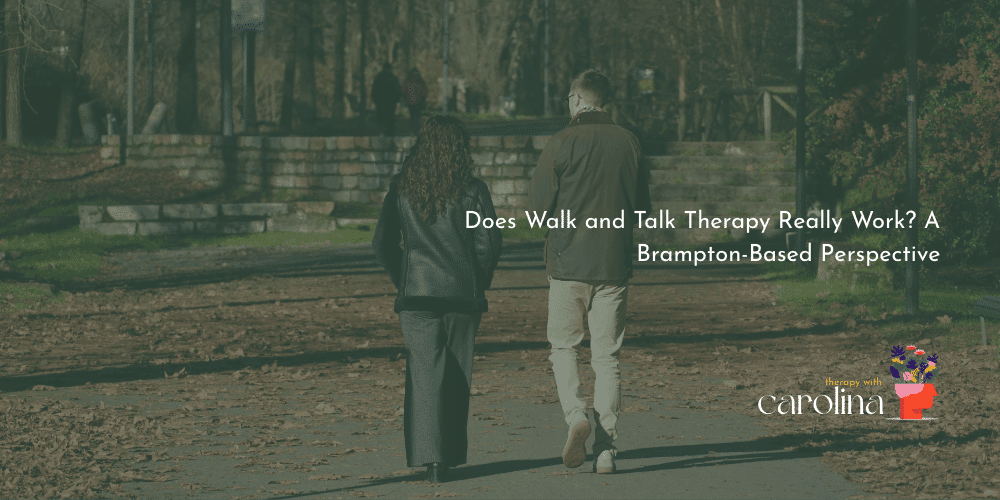
If you’ve ever felt boxed in by traditional therapy (literally or figuratively) you’re not alone. Many people do great work in the therapy room, and many others get stuck there. That’s where Walk and Talk therapy in Brampton steps in: not as a gimmick and not as “therapy lite” , but as a real, evidence-supported way to meet you where you are, outdoors, in motion, and in your own Brampton community.
In this article we’re going beyond definitions. You’ll learn:
- what a typical Walk and Talk thereapy session looks like
- how it can be different (and sometimes more effective) than office therapy
- who it’s right; and not right, for
- how nature influences mental health in measurable ways
- what benefits are backed by research
Let’s walk through it (pun entirely intended).
Walk and Talk therapy is exactly what it sounds like: therapy that happens while walking, usually outdoors, in nature. It’s also called “outdoor therapy” or “ecotherapy,” and it blends therapeutic conversation with gentle movement in a natural environment rather than sitting in a room.
Think of it as traditional talk therapy; the same professional care you’d expect in an office but with wind in the air, sun on your skin, and space to breathe. It’s not hiking therapy, it’s not fitness therapy, and it’s definitely not yoga class, because it’s still therapy. But the setting and flow are different, and that difference matters.
As experienced and compassionate counsellor offering Walk and Talk Therapy in Brampton, I offer a free 30 minute no obligation session to help answer questions you might have.
Why Some People Prefer It
The Power of Side-by-Side vs. Face-to-Face
Sitting across from another person can feel intimidating. You might overthink what to say, how you’re being perceived, or whether you “sound okay.” When you walk side by side with a therapist, that dynamic changes.
Side-by-side movement reduces pressure, often making it easier for people to open up, stay present, and process stuff in real time. Walking engages the nervous system differently, as physical movement doesn’t just get your legs moving; it can loosen psychological tension too.
Many clients find the conversation flows more naturally when they’re walking with someone rather than looking at them.
A Typical Walk and Talk Therapy Session
Now for the practical stuff you really want to know.
1. Check-In & Intention
We can meet at an agreed outdoor location, like a park trail, quiet greenway, or other safe, accessible space. Or we begin from my office, located 2 minutes from the Etobicoke Creek trail. There’s a brief check-in: what’s on your mind, what your goals are for the day.
2. Movement With Meaning
We walk, as much or as little as feels right, always at your pace. Sometimes that means a slow stroll. Sometimes it means stopping and sitting on a bench. The walk serves as context, the cardio is just an added benefit.
During the walk, discussion unfolds organically. Sometimes the scenery influences the conversation: a rustling tree here, a stream there can become useful metaphors or anchors during reflection.
3. More Presence, Less Performance
One of the stresses of traditional therapy is “performing” choosing the right words, matching eye contact, solving things on command. Walking together lifts that pressure. Some clients describe Walk and Talk therapy as collaboration.
4. Wrap-Up & Integration
At the end, we review insights and plan how to carry them forward. The session concludes with clarity, not chairs and walls.
So Does It Actually Work?
Short answer: yes, but with context.
And we’re going to unpack that honestly.
Nature and Mental Health Are Linked by Research
There’s growing evidence that being outdoors supports emotional wellbeing (science is finally catching up with what our Ancestors always knew).For instance, being in green spaces can lower stress, reduce anxiety, and improve mood through natural mechanisms like reduced cortisol levels and increased parasympathetic (rest-and-digest) activation.
Walking itself triggers the release of “feel-good chemicals” in the brain — endorphins, serotonin, and dopamine helping improve mood and cognitive clarity.
Being outside also supports mindfulness: the sights, smells, and sensations of nature anchor your attention in the present moment, reducing rumination and emotional overload.
Emotionally, forward motion mirrors the work clients are often doing internally: moving through stuck patterns, processing experiences, and building momentum toward change. For many people, especially those who feel restless, overwhelmed, or disconnected in indoor settings, walk and talk therapy allows the body to participate in the healing process rather than being asked to sit still while the mind does all the work.
So yes, nature matters. But therapy still matters too. The benefits pile up when therapeutic skills and outdoor context meet in a Walk and Talk therapy session.
Who Walk and Talk Therapy Is Great For (And Who It May Not Be)
Good Fit
- People who feel stiff, anxious, or claustrophobic in therapy offices
- Those who think more clearly when moving
- A great neuro-affirming approach for neurodivergent individuals
- Clients who want to integrate body and mind in their healing
- People working through stress, transition, burnout, and anxiety
- Creative thinkers who get stuck sitting still
Not the Best Fit
Walk & Talk therapy is not a universal replacement for every therapeutic need.
People who may do better with indoor sessions include:
- Those needing higher privacy levels due to sensitive topics
- Clients with mobility limitations that make walking uncomfortable
- Individuals who prefer non-movement based introspection
In many cases, a hybrid model that includes some indoor, some outdoor sessions can be the best of both worlds.
Five Benefits of Walk and Talk Therapy Backed by Both Research and Everyday Experience
Here are benefits clients often feel and science often supports:
1. Reduced Stress & Anxiety
Nature has a calming effect, often lowering stress markers and promoting relaxation.
2. Better Mood Through Movement
Physical activity releases chemicals linked to emotional balance and better cognitive function.
3. Improved Therapeutic Rapport
Walking side by side dissolves formality, creating a more balanced, collaborative interaction.
4. Increased Creativity & Clarity
Clients often find solutions feel less rigid when they’re not staring at four walls. Creative insight is a side effect of movement plus reflection.
5. Engagement With the Body
Talk therapy can feel brain-heavy for some people. Walk & Talk integrates the body without losing the focus on emotion and cognition.
Practical Questions About Walk and Talk Therapy in Brampton
Do you walk the entire time?
Not always. Some sessions are a slow stroll, some split time between walking and seated reflection. The goal is comfort and insight, not mileage.
How private is it?
Outdoor sessions are private in spirit but not sealed off like a room. We choose times and places that minimize foot traffic, and confidentiality conversations happen upfront.
What if the weather changes?
We plan for the weather in advance and have contingency options. Safety and comfort are always first.
What should I wear?
Comfortable shoes and weather-appropriate layers. Remember: this is therapy, not a fashion runway.
A Little Humor (Because Therapy Shouldn’t Always Be Serious)
Think of Walk and Talk therapy as the counselling version of upgrading from 2D to 3D. Same depth, just with fresh air and lungs that get a little love. No treadmills, no pressure. Just human beings having real conversations in nature.
Therapy That Meets You Moving
Walk and Talk therapy isn’t an escape hatch from traditional therapy. It’s a complementary way of working and one that respects the environment your nervous system actually lives in. If the idea of tapping into movement, nature, and conversation without walls feels like a breath of fresh air, you’re not imagining things. There’s real psychological currency there, real results for many people and an everyday body of research behind it. If you’re in Brampton and curious about a session that feels like walking your talk (yes that pun was intended), this approach might just be what helps you finally move through what’s been stuck.
Carolina Gutiérrez is a Registered Social Service Worker and Hypnotherapist with over 20+ years of clinical experience. She is a member in good standing with the College of Social Workers & Social Service Workers of Ontario. Her practice focus areas are entrepreneurship, infertility, childhood sexual abuse, childhood trauma/neglect, life transition and spiritual exploration. Carolina approach’s mental wellness from a holistic perspective, incorporating her professional training, spirituality and somatic work through the lens of her Ancestral Wisdom practices of Curanderismo. Therapywithcarolina.ca is a Downtown Brampton, Ontario based Therapy and Counselling practice offering in person, virtual, walk & talk sessions and group programs for clients both in Ontario and Internationally.
Service areas include but are not limited to Toronto, North York, Scarborough, Etobicoke, Mississauga, Vaughan, Oakville, Orangeville, Caledon, Bolton, Burlington, Thornhill, Richmond Hill, Markham, Stouffville, Newmarket, Aurora, Scarborough, Pickering, Ajax, Whitby, Oshawa, Milton, Dundas, Georgetown, Maple, King City, Halton Hills, Hamilton, Stoney Creek, Niagara Region, Guelph, Kitchener, Uxbridge, Georgina, Barrie, London, Erin, Fergus, Grimsby, St.Catharines, Chadham-Kent, Windsor, Belleville, Kingston, Ottawa, Orillia, Grimsby, Lincoln, Niagara Falls, Sarnia, Peterborough, Stratford, Collingwood, Waterloo, Innisfil, Cornwall, Perth, Coburg, Cawartha Lakes, Welland, Port Colborn, St.Thomas.
Phone: 289 513 6321 | Email: [email protected]| therapywithcarolina.ca